Yeah, but that doesn't explain why permanent DST instead of just ending DST. "People don't like switching clocks, and I've got the solution! Let's make the mass delusion permanent!" Can we just end the madness altogether?
Despite the terminology making it sound like DST is the exceptional state, it's actually DST for almost twice as long as non-DST: out of this year, 238 days of DST to 127 days off DST.
I'm surprised this argument is so hidden in the comments. All things being equal I would prefer permanent standard time, but it's pretty obvious that a very rational way to solve this problem is just choose whichever setting we use the majority of the time.
All of them are delusion. It's simply something we, as society, agreed on, many years ago. It comes to personal preference and for many people more daylight in the afternoon is more convenient.
No they're not all delusion, one is an abstraction, the others are delusion.
Noon is when the sun is 50% done with its cycle from rise to set. We base our clocks on that. Not delusion, abstraction. It is simply a measure of objective reality.
Deciding that noon is at 1:00pm on the longest days of the year so that the sun can set at night instead of evening is delusion. Deciding to make that permanent all year around isn't any better.
Noon hasn't meant high noon in nearly 150 years. With the establishment of timezones in 1883, we shifted from "noon is the highest point in the sky" to "noon is when we decide makes the most sense logistically for your general region". It came with an outcry of the same argument you're making.
Not the same argument. Not all outcry is supported by the same level of reasoning.
Time zones boil down to "for consistency's sake, we cannot have an infinitely granular way of setting time across longitudes" and people chopped the world into slices. At the middle of each slice, noon is supposed to be noon and is denoted with "12:00(pm)". This is a sensible compromise between clocks changing by the second based on GPS coordinates and the whole world having the same time. " noon is when we decide makes the most sense logistically" is not the argument here, it takes the nuance out. Noon is when, at the middle of the time zone, the sun is midway in the daylight part of the cycle. This is the crux of it, not simply "we all decided". We all decided because of something. there has to be a basis in reality, otherwise society is just shared delusion and things go off the rails quickly.
Literally all applications of numbers to time keeping is something we all decided. Society in a lot of ways is a shared delusion.
Hell, the application of 12 to high noon is relatively new. For the Romans, it was the transition between the sixth and seventh hours of the day, but they thought of it as the end of the sixth hour. Because of this, 'six/seis' is the root word of 'siesta', the mid day break in Spanish speaking countries.
Society is not going to "go off the rails quickly" as you suggest just from us moving the numerals we decided in the first place to new temporal locations, locations that we've moved them to and from twice a year for over a century.
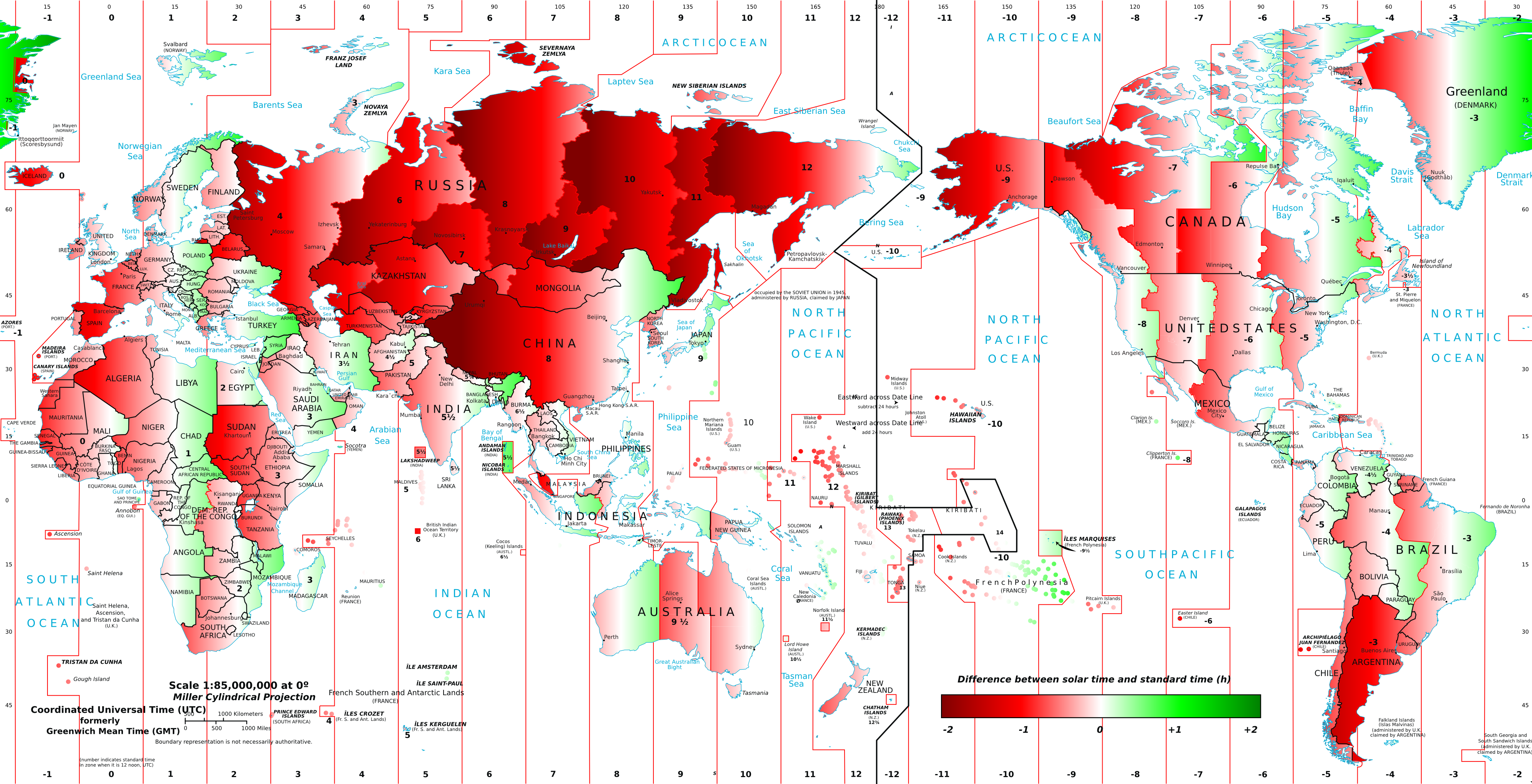
You got that backward. Everywhere in the red gets worse during DST. In Ohio, the middle of the day occurs at 1pm on EST, and the middle of the day occurs at 2pm on DST.
That was the point, but on closer inspection, it turns out Oahu is right about where it ought to be, and the pieces sticking out into the next logical time zone are mostly uninhabited. So my anger was in fact irrational.
Somehow our dog adjusted to DST on his own this time. I don't know how, he normally wakes us up at 7:30 am to go out in the morning (right before my alarm goes off)... since Sunday's DST change he's been waking us up when the clock reads 7:30 under DST - I don't know what cue he's using, it's got to be traffic or a neighbor, my best guess is that a neighbor is letting their dog out at the same time every morning and our dog hears it.
> DST has a high cost to anyone who is responsible for creatures that do not understand it - children and pets.
In addition, people who don't think it's a big deal because other people have dealt with the problems is causes for them or they have been statistically lucky in never having had a related problem.